Which Advanced Framework Involves Self-Organizing Multiple Interacting Agents in a Shared Environment?
Artificial intelligence is no longer limited to a single model working on one task. Modern AI systems can involve multiple autonomous agents that communicate, coordinate their activities, and respond to changes around them.
This brings us to the question:
Which advanced framework involves self-organizing multiple interacting agents in a shared environment?
The answer is MAS, or Multi-Agent Systems.
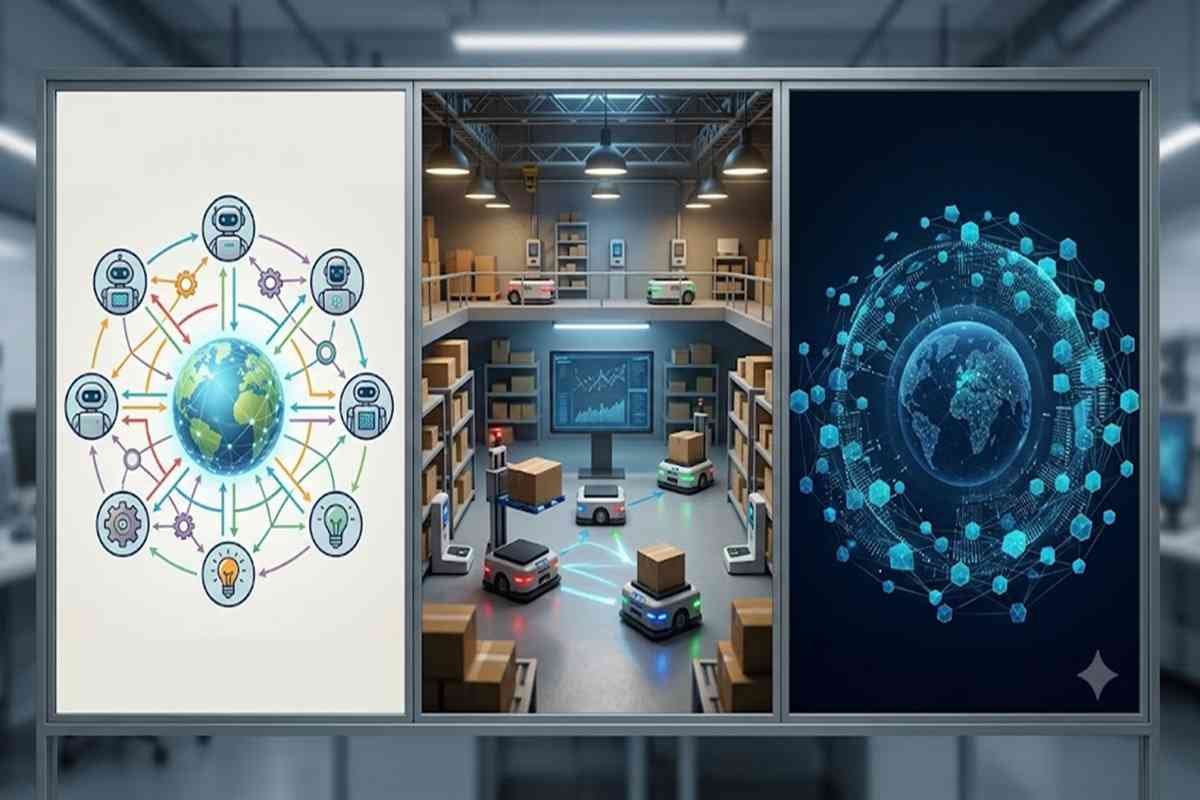
A Multi-Agent System is an approach in artificial intelligence and distributed computing where several autonomous agents operate within the same environment. These agents can have different responsibilities, goals, information, and decision-making abilities. They may cooperate, compete, negotiate, or independently respond to changes in their environment.
TL;DR: Which Framework Involves Multiple Interacting Agents?
Answer: MAS – Multi-Agent Systems.
MAS is designed around multiple autonomous agents that interact with one another and their environment. Instead of putting every responsibility into one central AI system, tasks and decisions can be distributed among several agents.
Quick Comparison
| Framework | Main Purpose | Is It the Answer? |
|---|---|---|
| RAG | Retrieves information to improve AI-generated responses | ❌ |
| LAM | Focuses on AI systems that perform actions | ❌ |
| MAS | Multiple interacting autonomous agents | ✅ |
| LLMOps | Managing and operating LLM applications | ❌ |
What Is a Multi-Agent System?
A Multi-Agent System (MAS) is a system made up of multiple agents that can independently observe information, make decisions, and take actions.
An agent could be:
- An AI-powered software program
- A chatbot
- An autonomous robot
- A virtual assistant
- A simulated character
- A specialized AI agent
- A decision-making software component
The agents operate within an environment and can influence each other through communication, shared information, or changes they make to that environment.
A simple representation is:
Agent A + Agent B + Agent C → Shared Environment → Interaction → Collective Result
The important point is that MAS focuses on the relationship and interaction between agents, rather than simply having several independent AI programs. Research and industry explanations of MAS commonly emphasize autonomy, interaction, distributed decision-making, and shared environments.
How Does a Multi-Agent System Work?
A MAS generally involves several stages of interaction.
1. Agents Observe Their Environment
Agents first gather information about what is happening around them.
For example, imagine several warehouse robots. Each robot may need to know:
- Where it is located
- Which items need to be moved
- Where other robots are operating
- Which routes are available
- Whether an obstacle is present
Each agent may have only a partial view of the complete environment.
2. Agents Make Decisions
After receiving information, an agent determines what it should do next.
Its decision may depend on:
- Its assigned objective
- Current environmental conditions
- Information received from other agents
- Available resources
- Rules or constraints
- Previous actions
3. Agents Interact
Agents can communicate directly through messages or indirectly by changing something in the shared environment.
For example:
Robot A reserves a route → Robot B detects the occupied route → Robot B selects another route
This interaction can happen repeatedly.
4. Agents Adapt Their Actions
If the environment changes, agents can modify their decisions.
For example, if one robot stops working, nearby robots may redistribute tasks.
5. Collective Behaviour Emerges
The overall behaviour of the system can become more complex than the behaviour of any individual agent.
This is one of the interesting characteristics of multi-agent approaches: local decisions and interactions can contribute to system-level behaviour.
What Does Self-Organizing Mean in MAS?
The phrase self-organizing is important in this question.
Self-organization means that a system can develop coordinated or organized behaviour through interactions between its components rather than requiring a person or central controller to dictate every individual action.
Consider a group of autonomous drones searching a large area.
Instead of giving every drone a fixed route, the system could allow each drone to:
- Check its current location.
- Identify nearby drones.
- Determine which areas have already been covered.
- Select an available area.
- Share relevant information.
- Change its route when conditions change.
Together, these individual decisions can create an organized search pattern.
Research on self-organizing multi-agent systems specifically examines how local interactions between autonomous agents can produce broader system behaviour without requiring complete centralized control.
Key Components of a Multi-Agent System
A typical MAS contains several important components.
Autonomous Agents
These are the individual decision-making entities within the system.
Each agent may have:
- A specific role
- Individual goals
- Knowledge or memory
- Decision-making logic
- Communication capabilities
- Tools or actions
Shared Environment
The environment is the space in which the agents operate.
It could be:
- A physical warehouse
- A road network
- A virtual simulation
- A computer network
- A business workflow
- An online marketplace
The environment can provide information and constraints that influence agent decisions.
Communication
Agents need some mechanism to exchange information.
Communication could happen through:
- Direct messages
- Shared databases
- APIs
- Events
- Common memory
- Environmental changes
Goals
Agents can have either individual objectives or a common goal.
For example:
Individual goal: Each delivery robot wants to complete its assigned delivery.
Shared goal: All robots need to complete the warehouse order as efficiently as possible.
MAS vs Single-Agent AI
The difference becomes easier to understand when comparing a multi-agent architecture with a single AI agent.
| Feature | Single-Agent AI | Multi-Agent System |
|---|---|---|
| Agents | One | Multiple |
| Responsibilities | Usually centralized | Can be distributed |
| Communication | Not usually between agents | Important |
| Decision-making | Mainly one agent | Multiple agents |
| Coordination | Limited | Central feature |
| Environment | Agent interacts with environment | Agents interact with each other and environment |
| Complex workflows | Can become difficult | Can divide responsibilities |
| Emergent behaviour | Limited | More relevant |
A single agent can be perfectly suitable for a straightforward task. MAS becomes more useful when the problem contains multiple roles, competing objectives, distributed information, or many entities that need to interact.
MAS vs RAG
A common mistake is confusing MAS with RAG.
RAG
RAG stands for Retrieval-Augmented Generation.
It allows an AI model to retrieve relevant information from an external knowledge source before generating an answer.
A simplified RAG workflow is:
User Question → Retrieve Information → AI Model → Response
MAS
A multi-agent system follows a different concept:
Multiple Agents → Communication → Coordination → Decisions → Actions
RAG can actually be used inside a MAS.
For example, one agent could retrieve information while another agent analyzes that information.
So:
RAG = information retrieval approach
MAS = multi-agent architecture
MAS vs LLMOps
LLMOps is another term that can appear in AI-related questions.
LLMOps focuses on managing applications built around large language models.
It can involve:
- Deployment
- Monitoring
- Model evaluation
- Cost management
- Security
- Version control
- Performance monitoring
LLMOps does not specifically describe multiple autonomous agents interacting inside a shared environment.
Therefore, the distinction is straightforward:
MAS → Multiple interacting agents
LLMOps → Managing LLM-based systems
MAS vs LAM
LAM is generally used to describe Large Action Models, which focus on AI systems capable of taking actions and interacting with applications or digital environments.
LAM and MAS are not interchangeable concepts.
A multi-agent system could potentially use action-oriented AI models inside individual agents, but MAS specifically describes the multi-agent structure and interaction model.
Real-World Applications of Multi-Agent Systems
Multi-agent architectures can be useful in many fields.
Autonomous Robots
Multiple robots can coordinate tasks in environments such as:
- Warehouses
- Factories
- Agricultural fields
- Disaster zones
Each robot can make local decisions while contributing to a broader objective.
Traffic Management
Vehicles, traffic signals, road sensors, and other entities can be modeled as interacting agents.
A simulation can then study how changes in individual behaviour affect overall traffic flow.
Drone Coordination
A collection of drones can divide a large area into sections and coordinate their movements.
Potential applications include:
- Mapping
- Search and rescue
- Environmental monitoring
- Infrastructure inspection
Financial Simulations
MAS can simulate different market participants, such as buyers and sellers, to study how individual decisions influence broader market behaviour.
Supply Chain Management
Different agents can represent:
- Suppliers
- Warehouses
- Transport providers
- Retailers
- Customers
The system can then model how changes in one part of the supply chain affect other participants.
Multi-Agent Systems in Generative AI
The rise of AI agents has made MAS especially relevant to modern generative AI.
Instead of asking one LLM-powered agent to perform an entire complex workflow, an organization can divide responsibilities between specialized agents.
For example:
Research Agent
↓
Finds and organizes information
Analysis Agent
↓
Examines the collected information
Planning Agent
↓
Creates an action plan
Execution Agent
↓
Carries out approved tasks
Review Agent
↓
Checks the result
This type of architecture can be useful when different stages require different capabilities.
Modern multi-agent AI research is also investigating systems in which agents dynamically coordinate, delegate work, and adapt their roles.
Advantages of Multi-Agent Systems
Distributed Decision-Making
Decisions can be spread across multiple agents instead of relying entirely on one central controller.
Task Specialization
Each agent can focus on a particular responsibility.
Parallel Work
Multiple agents can potentially work on different parts of a problem at the same time.
Adaptability
Agents can respond to changes in their environment and interactions.
Scalability
Some MAS architectures can add additional agents when the workload increases.
Resilience
A properly designed decentralized system may continue operating even if one agent becomes unavailable.
However, these benefits depend heavily on system design. Adding more agents does not automatically improve an AI application.
Also Read: How Does an AI Agent Work? Understanding the Technology Behind Intelligent AI Systems
Challenges of Multi-Agent Systems
Multi-agent architectures also introduce additional complexity.
Coordination
Agents may make decisions that conflict with one another.
Communication Overhead
A large number of agents exchanging information can increase system complexity and resource usage.
Conflicting Objectives
Agents may have different goals.
Unpredictable Emergent Behaviour
The combined behaviour of many interacting agents can sometimes be difficult to predict.
Security
Agents may have access to tools, information, or other systems, so permissions need to be carefully controlled.
Testing
Testing a single agent is generally easier than testing a system where many agents continuously interact.
When Should You Use MAS?
A multi-agent approach makes the most sense when a problem naturally involves multiple roles or decision-makers.
You may consider MAS when:
- A task can be divided into specialized responsibilities.
- Multiple AI agents need to communicate.
- Different agents require different tools.
- The environment changes frequently.
- Agents need to coordinate or negotiate.
- The problem is too broad for one agent.
- Distributed decision-making provides an advantage.
For a simple task, however, a single AI agent may be the better solution.
Simple Example of MAS
Imagine an AI-powered content marketing team.
Instead of one AI system handling everything, you could have:
Keyword Research Agent
Finds search opportunities.
↓
Content Strategy Agent
Groups keywords according to intent.
↓
Content Brief Agent
Creates article requirements.
↓
SEO Review Agent
Checks optimization elements.
↓
Human Editor
Reviews and approves the final work.
Each agent has a different responsibility, but they operate as part of one larger workflow.
That is the basic idea behind a modern AI-based multi-agent architecture.
Frequently Asked Questions
Which advanced framework involves self-organizing multiple interacting agents in a shared environment?
The answer is MAS (Multi-Agent Systems). It involves multiple autonomous agents that interact with one another and operate within a shared environment.
What does MAS stand for?
MAS stands for Multi-Agent Systems.
What is the main idea behind MAS?
The main idea is to create a system where multiple autonomous agents can interact, communicate, make decisions, and work toward individual or shared objectives.
Is MAS the same as AI agents?
Not exactly. An AI agent is an individual autonomous entity. MAS refers to an architecture or system containing multiple interacting agents.
Can LLMs be used in MAS?
Yes. LLMs can provide reasoning, planning, communication, or decision-making capabilities for individual agents within a multi-agent architecture.
Is RAG a Multi-Agent System?
No. RAG is a retrieval-based approach for improving generative AI responses. It can be incorporated into a MAS, but it is not itself a multi-agent framework.
What is the difference between MAS and a single AI agent?
A single-agent system uses one primary agent to complete a task, while MAS distributes responsibilities among multiple interacting agents.

Related Posts