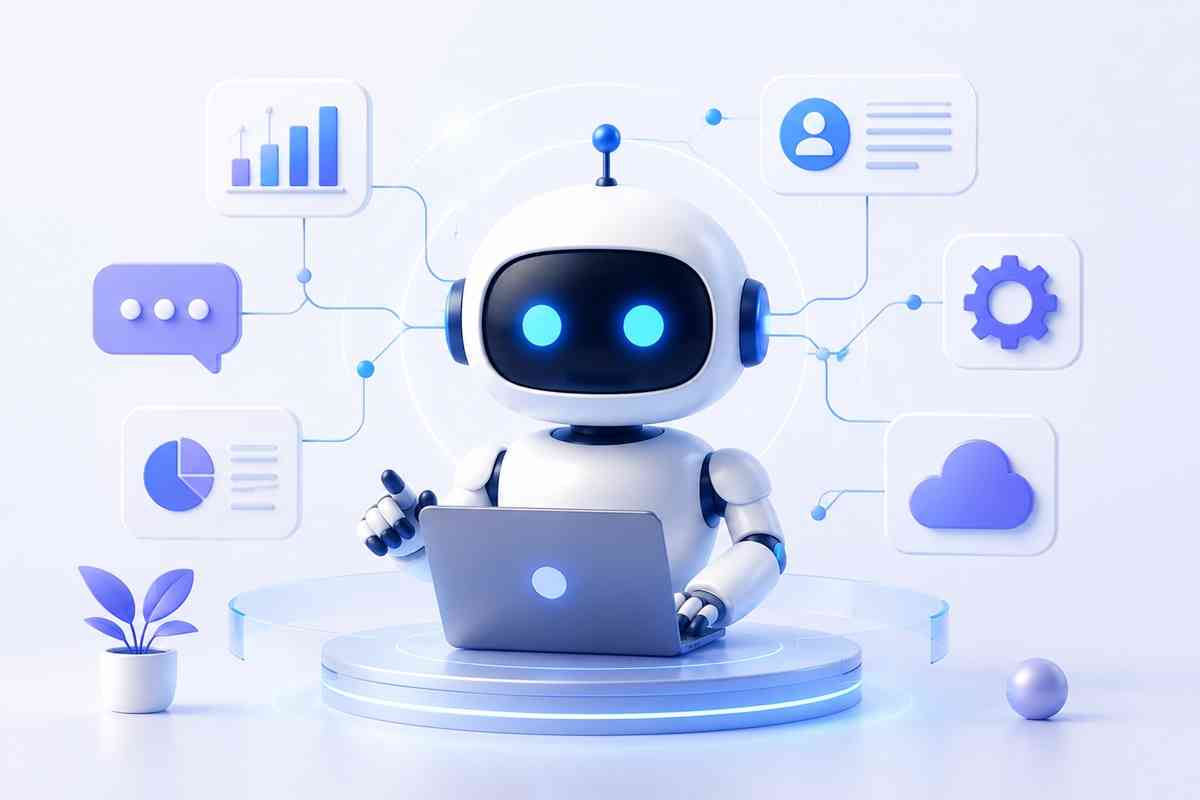
AI agents are transforming how businesses automate tasks, interact with customers, and make decisions. From virtual assistants to autonomous business tools, AI agents can analyze information, reason through problems, and take actions with minimal human intervention. Understanding how an AI agent works helps organizations and professionals leverage artificial intelligence more effectively in today’s digital landscape.
What Is an AI Agent?
An AI agent is an intelligent software system that can perceive information, process data, make decisions, and perform actions to achieve specific goals.
Unlike traditional software that follows fixed instructions, AI agents can:
- Analyze context
- Learn from interactions
- Use external tools
- Execute complex workflows
- Adapt to changing situations
Modern AI agents combine machine learning, large language models (LLMs), automation tools, and memory systems to perform tasks that previously required human involvement.
How Does an AI Agent Work?
An AI agent operates through a continuous cycle of observing, thinking, planning, and acting.
At a high level, the workflow follows these stages:
- Input Collection
- Data Processing
- Reasoning and Decision-Making
- Action Execution
- Learning and Improvement
Each stage plays a critical role in helping the AI agent accomplish its objectives.
The AI Agent Workflow Explained
1. Receiving Input From the Environment
The first step in how an AI agent works is collecting information from various sources.
Input may come from:
- User prompts
- Business databases
- Documents
- APIs
- Sensors
- Websites
- CRM systems
For example, a customer support AI agent receives a customer query and begins analyzing the request.
This process is known as perception.
2. Understanding the User’s Intent
After collecting information, the AI agent uses Natural Language Processing (NLP) to understand the meaning behind the input.
The agent identifies:
- User intent
- Context
- Keywords
- Sentiment
- Relevant entities
For example, if a user asks:
“Can you schedule a meeting for tomorrow?”
The AI agent understands:
- The task is scheduling
- A calendar tool is required
- The timeframe is tomorrow
This contextual understanding is one of the major advantages of modern AI systems.
3. Accessing Memory and Knowledge
Most advanced AI agents include memory systems.
Memory helps agents:
- Remember previous conversations
- Store important information
- Maintain context
- Improve personalization
Types of AI memory include:
Short-Term Memory
Stores recent interactions during an active session.
Long-Term Memory
Stores historical information across multiple interactions.
Knowledge Memory
Contains facts, documents, business data, and organizational knowledge.
Memory allows AI agents to provide more accurate and relevant responses.
4. Reasoning and Decision-Making
Reasoning is the intelligence layer of an AI agent.
At this stage, the agent evaluates available information and determines the best course of action.
Modern AI agents often use:
- Large Language Models (LLMs)
- Machine Learning Algorithms
- Knowledge Graphs
- Rule-Based Systems
The reasoning engine answers questions such as:
- What is the goal?
- What steps are required?
- Which tools should be used?
- What information is missing?
This process enables AI agents to solve complex problems.
5. Planning the Task
Before taking action, the AI agent creates a plan.
Complex tasks are broken into smaller steps.
For example:
Goal: Generate an SEO report
Plan:
- Access analytics data
- Analyze traffic
- Identify trends
- Generate insights
- Create report
This planning capability separates AI agents from traditional automation software.
6. Using External Tools
One of the most powerful features of modern AI agents is tool usage.
AI agents can interact with external systems such as:
- Search engines
- Email platforms
- Databases
- Calendars
- CRM software
- Project management tools
For example, an AI sales agent can:
- Search lead information
- Send emails
- Schedule meetings
- Update CRM records
Tool integration significantly expands the agent’s capabilities.
7. Executing Actions
After planning, the AI agent performs the required actions.
Examples include:
- Sending notifications
- Creating reports
- Generating content
- Booking appointments
- Updating records
- Responding to customers
Execution transforms analysis into measurable outcomes.
This is where businesses experience the practical value of AI agents.
8. Evaluating Results
Once the task is completed, the AI agent evaluates the outcome.
Questions considered include:
- Was the goal achieved?
- Were there errors?
- Can the process be improved?
Performance evaluation helps optimize future decisions.
9. Learning From Feedback
Many advanced AI agents continuously improve through feedback loops.
The system analyzes:
- User feedback
- Success rates
- Error patterns
- New data
This learning process enhances future performance and accuracy.
Learning is one of the reasons AI agents become more effective over time.
Core Components of an AI Agent
Understanding how an AI agent works requires understanding its core architecture.
| Component | Function |
|---|---|
| Perception Layer | Collects data and inputs |
| NLP Engine | Understands language and intent |
| Memory System | Stores information |
| Reasoning Engine | Makes decisions |
| Planning Module | Creates task strategies |
| Tool Integration | Connects external systems |
| Action Layer | Executes tasks |
| Learning System | Improves performance |
These components work together to create intelligent autonomous behavior.
Real-World Example of How an AI Agent Works
Imagine an e-commerce customer asks:
“Where is my order?”
The AI agent performs the following actions:
- Understands the question.
- Identifies the customer’s order number.
- Accesses the order database.
- Retrieves shipping information.
- Generates a response.
- Updates the support ticket if necessary.
The entire process happens within seconds.
This demonstrates how AI agents automate complex workflows while improving customer experience.
Business Applications of AI Agents
Organizations use AI agents across multiple departments.
Customer Support
AI agents handle:
- FAQs
- Ticket routing
- Customer inquiries
- Complaint resolution
Marketing
Marketing teams use AI agents for:
- Content creation
- Keyword research
- Campaign analysis
- Social media management
Sales
Sales AI agents can:
- Qualify leads
- Schedule meetings
- Generate outreach messages
- Analyze customer behavior
Human Resources
HR departments use AI agents for:
- Resume screening
- Employee onboarding
- Internal support
- Candidate communication
Healthcare
Healthcare organizations use AI agents for:
- Patient support
- Appointment scheduling
- Medical documentation
- Administrative automation
Benefits of AI Agents
Organizations increasingly adopt AI agents because of their advantages.
Key Benefits
- Faster decision-making
- Increased productivity
- Reduced operational costs
- Better customer experience
- Continuous availability
- Business process automation
- Improved scalability
These benefits make AI agents valuable across industries.
Challenges of AI Agents
Despite their advantages, AI agents also face challenges.
Common Challenges
- Data privacy concerns
- Security risks
- Hallucinated responses
- Integration complexity
- Regulatory compliance
- Ethical considerations
Businesses should implement proper governance and monitoring systems.
Future of AI Agents
The future of AI agents is moving toward greater autonomy and collaboration.
Emerging developments include:
- Multi-agent systems
- Autonomous business operations
- AI-powered digital employees
- Industry-specific AI agents
- Advanced reasoning capabilities
- Personalized AI assistants
As artificial intelligence technology continues evolving, AI agents will become increasingly sophisticated and capable.
Conclusion
Understanding how an AI agent works is essential for businesses, developers, and professionals exploring artificial intelligence. AI agents combine perception, reasoning, memory, planning, and action to complete tasks autonomously. By leveraging machine learning, large language models, workflow automation, and external tools, AI agents can improve efficiency, reduce costs, and transform business operations.
As AI adoption accelerates worldwide, AI agents are expected to become a fundamental component of modern digital ecosystems.
Also Read: What are AI Agents? Concepts, Tools, Development & Business Applications
FAQs
1. How does an AI agent work?
An AI agent collects information, analyzes context, plans actions, executes tasks, and learns from outcomes to achieve specific goals.
2. What technologies power AI agents?
AI agents use machine learning, natural language processing, large language models, memory systems, and workflow automation tools.
3. How are AI agents different from chatbots?
AI agents can reason, plan, use tools, and perform actions, while traditional chatbots mainly provide conversational responses.
4. Can AI agents learn from experience?
Yes. Many AI agents improve through feedback loops, historical data, and machine learning techniques.
5. What industries use AI agents?
Healthcare, finance, marketing, customer support, education, retail, and software development widely use AI agents.
6. Are AI agents fully autonomous?
Some AI agents operate autonomously, while others require human supervision depending on the task complexity.
7. What are the main benefits of AI agents?
They improve productivity, automate repetitive tasks, reduce costs, and enhance customer experiences.
8. What is the future of AI agents?
Future AI agents will become more intelligent, collaborative, personalized, and capable of managing complex business processes.

Related Posts
2 thoughts on “How Does an AI Agent Work? Understanding the Technology Behind Intelligent AI Systems”