AI agents are rapidly transforming how businesses automate tasks, make decisions, and interact with customers. Unlike traditional software, AI agents can perceive information, reason, plan actions, and execute tasks with minimal human intervention. From customer support and content creation to software development and business automation, AI agents are becoming a key part of the modern artificial intelligence ecosystem.
What Are AI Agents?
AI agents are software systems powered by artificial intelligence that can independently perform tasks, make decisions, and interact with users or other systems to achieve specific goals.
Unlike basic chatbots, AI agents can:
- Understand context
- Analyze information
- Make decisions
- Use external tools
- Learn from feedback
- Complete multi-step tasks
An AI agent acts like a digital worker capable of handling responsibilities that previously required human intervention.
Why are AI Agents Important?
Businesses are adopting AI agents because they improve efficiency, reduce costs, and automate repetitive work.
Key Benefits of AI Agents
- Faster task execution
- Reduced operational costs
- 24/7 availability
- Improved customer experience
- Increased productivity
- Better decision-making
- Business process automation
As generative AI continues to evolve, AI agents are becoming a critical component of digital transformation strategies.
Core Components of AI Agents
Understanding the building blocks of AI agents helps explain how they operate.
1. Perception Layer
The perception layer collects information from various sources.
Examples include:
- User inputs
- Documents
- APIs
- Databases
- Websites
- Sensors
This information becomes the foundation for decision-making.
2. Reasoning Engine
The reasoning engine processes information and determines the best course of action.
Modern AI agents use:
- Large Language Models (LLMs)
- Machine Learning
- Knowledge Graphs
- Rule-Based Systems
Reasoning allows agents to understand context and solve problems.
3. Memory System
Memory enables AI agents to retain information across interactions.
Types of memory include:
- Short-term memory
- Long-term memory
- Context memory
- Knowledge memory
Memory improves personalization and task continuity.
4. Planning Module
Planning helps AI agents break large objectives into smaller actionable steps.
For example:
Goal: Generate a business report
Steps:
- Gather data
- Analyze trends
- Create summary
- Generate report
This structured planning improves task completion.
5. Action Layer
The action layer allows AI agents to perform tasks.
Actions may include:
- Sending emails
- Updating databases
- Creating documents
- Scheduling meetings
- Executing workflows
This is where AI agents deliver practical value.
Types of AI Agents
Different AI agents serve different purposes.
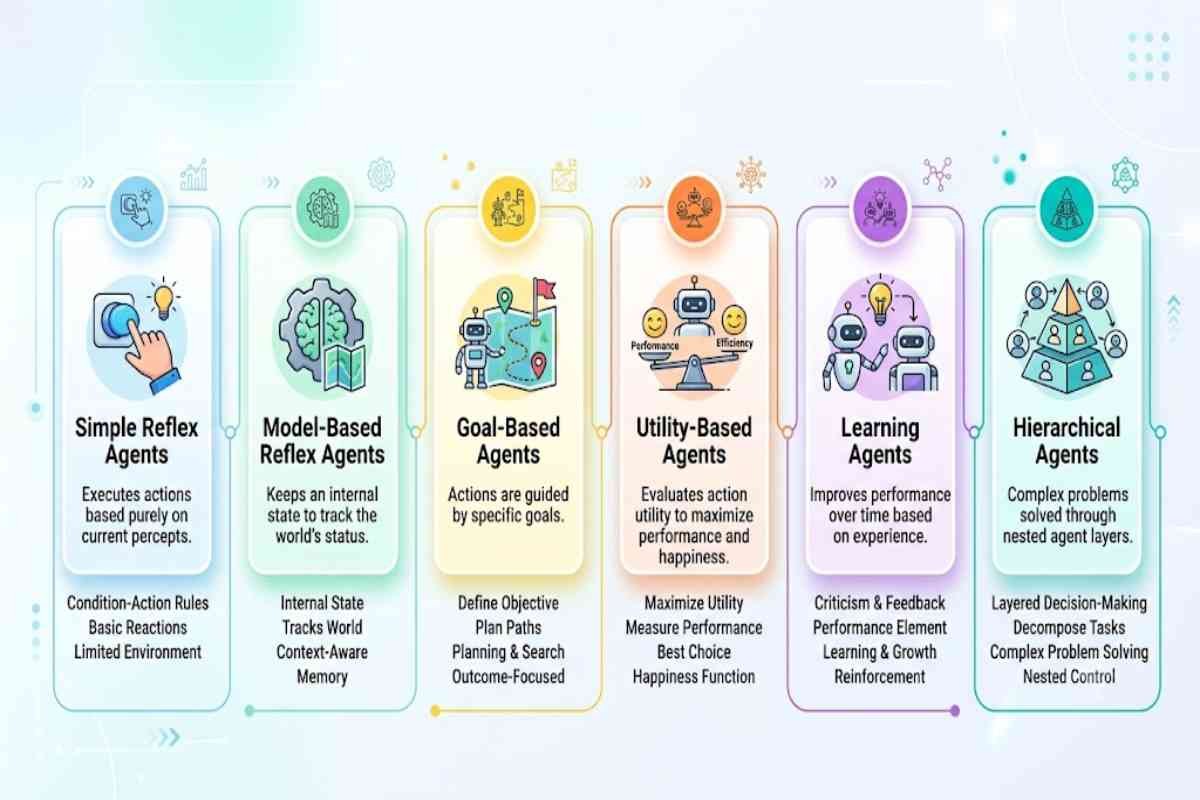
1. Simple Reflex Agents
These agents respond directly to inputs without maintaining memory.
Examples:
- Basic chatbots
- Rule-based automation systems
2. Model-Based Agents
Model-based agents maintain internal knowledge about their environment.
They make more intelligent decisions than simple reflex agents.
3. Goal-Based Agents
These agents work toward achieving specific objectives.
Examples:
- Route planning systems
- Project management assistants
4. Utility-Based Agents
Utility-based agents evaluate multiple options and choose the most beneficial outcome.
Examples:
- Investment recommendation systems
- Resource optimization tools
5. Learning Agents
Learning agents continuously improve using feedback and new data.
Examples:
- Recommendation engines
- Personalized assistants
- Adaptive AI systems
How AI Agents Work ?
The operation of an AI agent follows a structured process.
1. Receive Input
The agent collects information from users, databases, APIs, or documents.
2. Analyze Context
AI models interpret the meaning and context of the information.
3. Generate Plan
The agent creates a strategy to accomplish the assigned task.
4. Execute Actions
Tasks are performed through integrated tools and workflows.
5. Learn and Improve
Feedback helps optimize future performance.
This cycle allows AI agents to become increasingly effective over time.
Essential Tools Used for AI Agent Development
Several tools and frameworks are commonly used to build AI agents.
| Tool | Primary Purpose |
|---|---|
| LangChain | Agent workflows and orchestration |
| AutoGen | Multi-agent collaboration |
| CrewAI | Team-based AI agents |
| OpenAI API | Language intelligence |
| Vector Databases | Memory and retrieval |
| Pinecone | Semantic search |
| Weaviate | Knowledge storage |
| Hugging Face | AI models |
| Zapier | Workflow automation |
| Docker | Deployment and scaling |
These tools form the foundation of modern AI agent architecture.
10 Steps to Develop AI Agents
1. Define Business Objectives
Clearly identify the problem the AI agent will solve.
Examples:
- Customer support
- Lead generation
- Data analysis
- Content creation
2. Choose the Right AI Model
Popular models include:
- GPT models
- Claude models
- Open-source LLMs
- Industry-specific AI models
Model selection affects performance and cost.
3. Design Agent Architecture
Define:
- Inputs
- Memory
- Planning logic
- Output actions
A strong architecture improves scalability.
4. Integrate Data Sources
AI agents often require access to:
- Databases
- CRM systems
- APIs
- Knowledge bases
Data access improves decision quality.
5. Implement Memory
Memory allows agents to maintain context and support long-term interactions.
This significantly improves user experience.
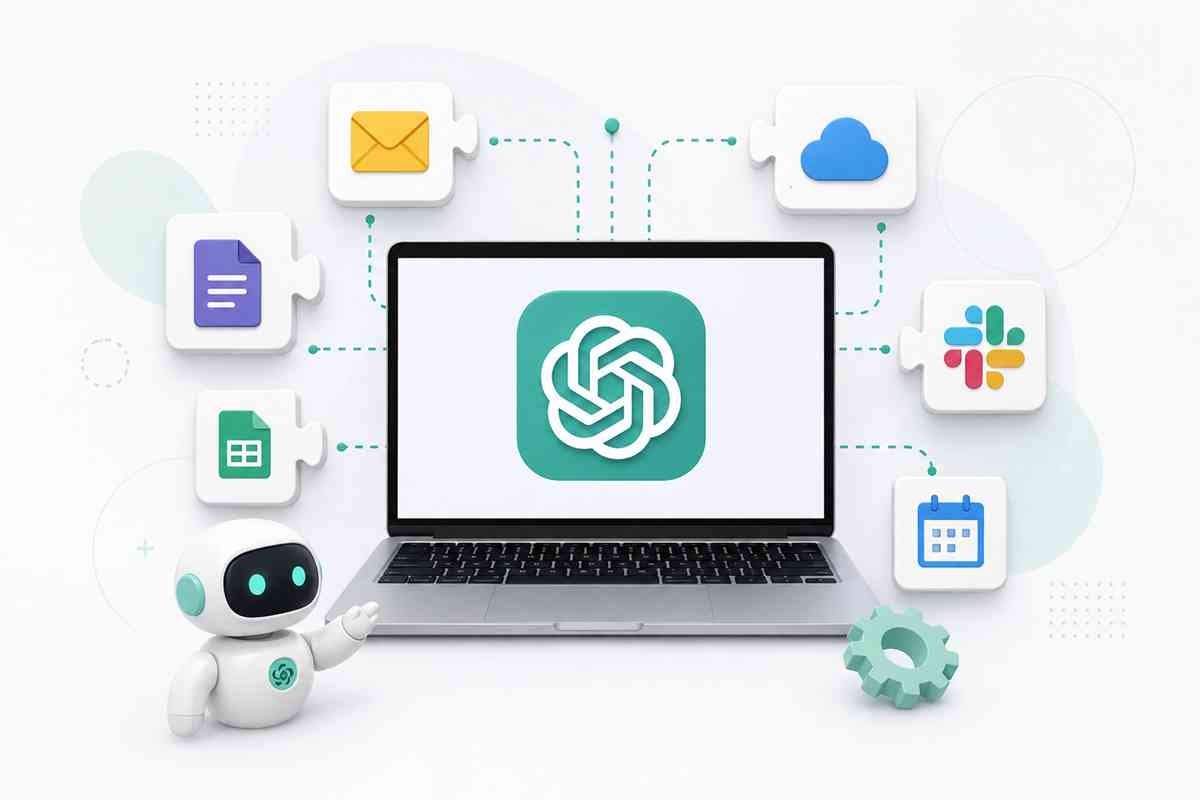
6. Add Tool Access
Tools expand the agent’s capabilities.
Examples:
- Web search
- Email systems
- Calendars
- Project management software
7. Create Workflows
Workflows define how tasks are completed from start to finish.
Automation workflows improve efficiency and consistency.
8. Test Agent Performance
Testing helps identify:
- Errors
- Hallucinations
- Workflow failures
- Security vulnerabilities
Regular testing is essential.
9. Deploy the Agent
Deployment options include:
- Cloud platforms
- Web applications
- Internal business systems
- Customer-facing products
10. Monitor and Improve
Continuous monitoring helps optimize performance and maintain reliability.
AI agents should evolve alongside business requirements.
Business Applications of AI Agents
AI agents are being adopted across industries.
Customer Support
AI agents handle:
- FAQs
- Ticket routing
- Complaint resolution
- Customer onboarding
Benefits include faster response times and lower support costs.
Sales and Lead Generation
AI agents can:
- Qualify leads
- Schedule meetings
- Personalize outreach
- Analyze customer behavior
This improves sales efficiency.
Marketing Automation
Marketing teams use AI agents for:
- Content generation
- Campaign analysis
- Social media management
- SEO optimization
Automation reduces manual effort.
Human Resources
HR departments use AI agents for:
- Resume screening
- Candidate communication
- Employee onboarding
- Internal support
Recruitment becomes faster and more efficient.
Finance and Accounting
AI agents assist with:
- Invoice processing
- Financial forecasting
- Fraud detection
- Expense management
This improves accuracy and reduces costs.
Healthcare
Healthcare applications include:
- Appointment scheduling
- Medical documentation
- Patient support
- Diagnostic assistance
AI agents help streamline healthcare operations.
Software Development
Development teams use AI agents for:
- Code generation
- Testing automation
- Bug detection
- Documentation
This accelerates software delivery.
Benefits of AI Agents for Businesses
Major Advantages
- Reduced operational expenses
- Increased productivity
- Better customer experiences
- Faster decision-making
- Improved scalability
- Continuous availability
- Enhanced business intelligence
Organizations using AI agents often gain a competitive advantage.
Challenges of AI Agents
Despite their benefits, AI agents present several challenges.
Common Challenges
- Data privacy concerns
- Security risks
- Hallucinated responses
- Integration complexity
- Regulatory compliance
- Maintenance requirements
- Ethical considerations
Organizations must implement governance and monitoring systems.
Future of AI Agents
The future of AI agents is expected to include:
Emerging Trends
- Autonomous AI workers
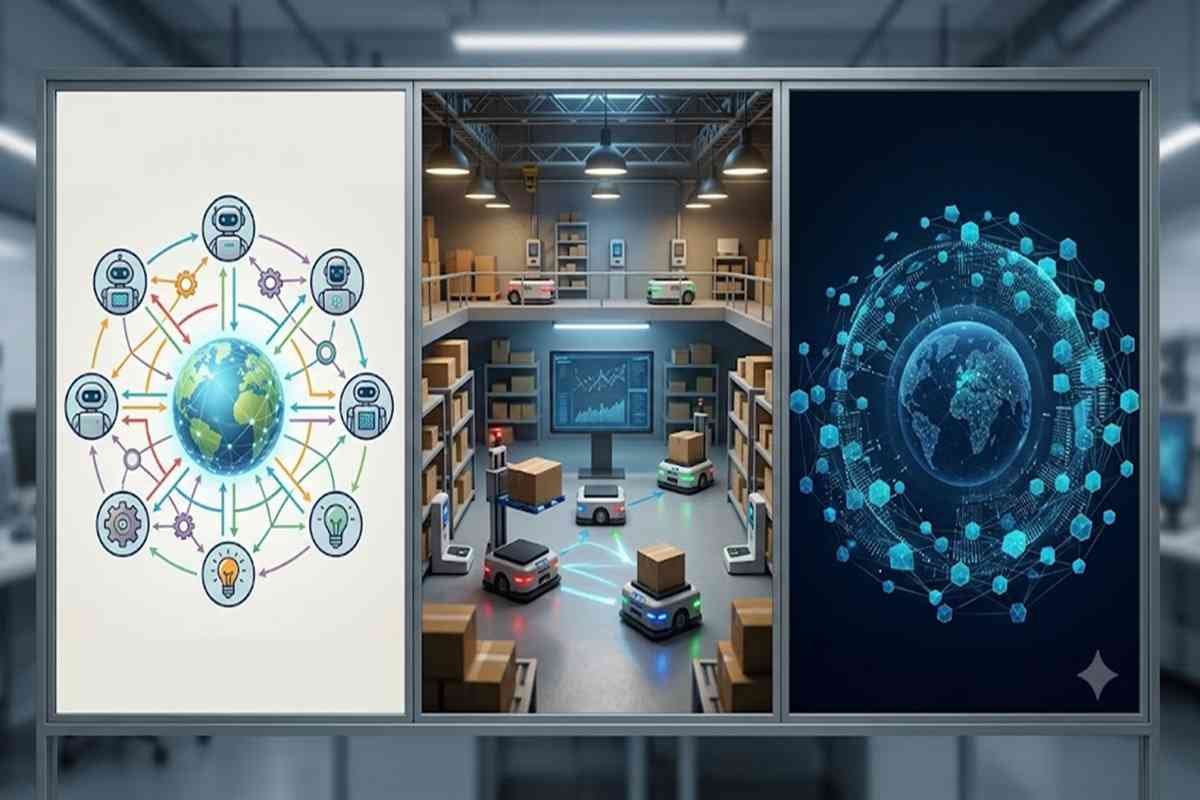
- Multi-agent collaboration
- Industry-specific AI agents
- AI-powered operating systems
- Advanced reasoning capabilities
- Personalized digital assistants
- Autonomous business processes
Experts predict AI agents will become standard tools across nearly every industry.
AI Agents vs Traditional Automation
| Feature | AI Agents | Traditional Automation |
|---|---|---|
| Decision Making | Intelligent | Rule-Based |
| Learning Ability | Yes | Limited |
| Adaptability | High | Low |
| Context Awareness | Yes | No |
| Complex Tasks | Supported | Limited |
| Human Intervention | Minimal | Often Required |
AI agents provide greater flexibility and intelligence compared to traditional automation systems.
Skills Required to Build AI Agents
Professionals working with AI agents should understand:
- Artificial Intelligence
- Machine Learning
- Prompt Engineering
- Python Programming
- APIs
- Cloud Computing
- Data Management
- Workflow Automation
These skills are increasingly valuable in the modern technology landscape.
Conclusion
AI agents represent the next evolution of artificial intelligence, combining reasoning, memory, planning, and action into autonomous systems capable of solving real-world problems. Whether used for customer service, marketing, software development, healthcare, or business automation, AI agents are helping organizations improve efficiency and unlock new opportunities.
As AI technology advances, businesses that understand and adopt AI agents will be better positioned to compete in an increasingly automated and intelligent digital economy.
FAQs
1. What is an AI agent?
An AI agent is an intelligent software system that can perceive information, make decisions, and perform tasks autonomously.
2. How do AI agents differ from chatbots?
AI agents can plan, reason, remember information, and perform actions, while traditional chatbots mainly provide responses.
3. Which industries use AI agents?
Healthcare, finance, retail, education, customer support, marketing, and software development widely use AI agents.
4. What tools are used to build AI agents?
Popular tools include LangChain, CrewAI, AutoGen, OpenAI APIs, Pinecone, and vector databases.
5. Can AI agents work without human supervision?
Some AI agents can operate autonomously, but most require monitoring and governance for critical tasks.
6. Are AI agents expensive to implement?
Costs vary depending on complexity, infrastructure, and model usage, but many businesses achieve strong ROI.
7. What programming language is best for AI agent development?
Python is the most widely used programming language for building AI agents and machine learning systems.
8. What is the future of AI agents?
Future AI agents will become more autonomous, collaborative, personalized, and capable of handling complex business workflows.

Related Posts
One thought on “What are AI Agents? Complete Guide to AI Agents: Concepts, Tools, Development & Business Applications”